What Is Mindfulness and Its Use in Daily Life
Dr. Daman Ahuja, SOHAMINDIA
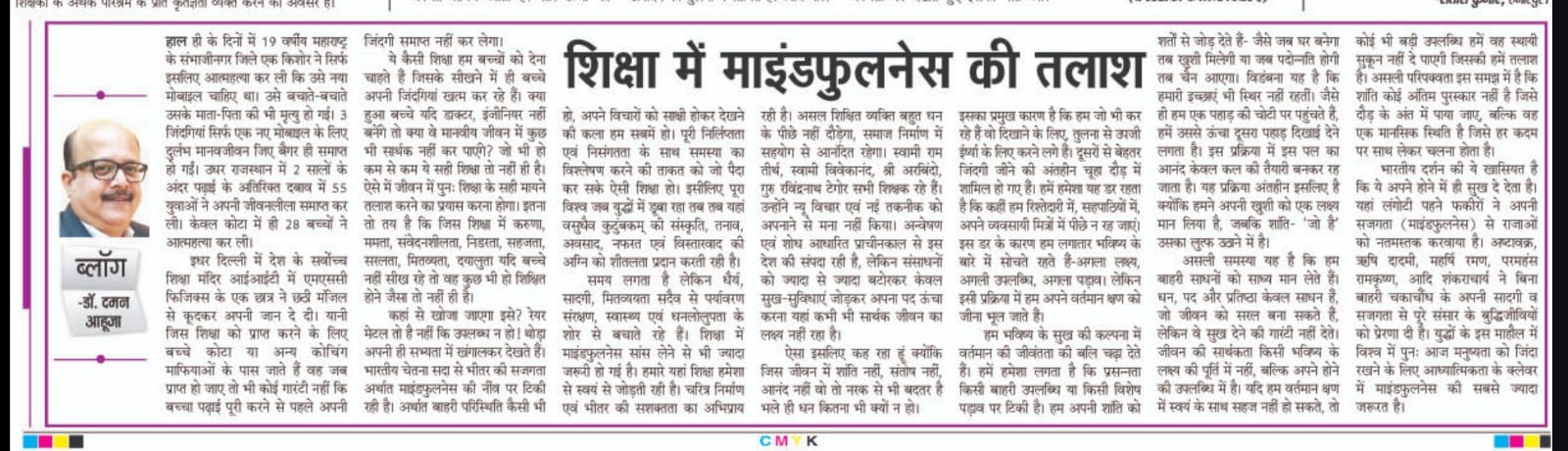
Mindfulness is not just about sitting for meditation for some time daily, though that does help us settle down amid the chaotic responsibilities and atmosphere around us. It also helps us settle peacefully and observe whatever exists in our lives, engraved in our minds. It gives us a clear picture of what is going on around us and helps us focus on our priorities, both logically and aesthetically. But it is also a complete lifestyle. It encompasses all the facets of mindfulness. It is also about seeing life without any pomp and show — recognizing what truly matters to us within the universal frame of existence. I elaborate on a few aspects here.
1. Frugal Living
Frugal living carries the plain meaning of living with fewer resources, without giving up the most essential needs. Though this varies from person to person, it generally means living within the resources available and never spending more than what one has. Second, when we live with fewer resources, we need less energy and time to manage them. Our basic needs are food, clothing, shelter, transport, and provisions for health emergencies. By fulfilling only these basic needs, we can save a great deal of time to spend with ourselves — perhaps on reading, writing, music, meditation, spiritual pursuits, drama, art, radio, welfare work, teaching, service, or anything else that adds meaning to life. Third, it reduces our consumption of natural resources that are limited by nature — water, forests, fresh air, and so on. With a mindset oriented toward living within limited resources, one need not live only in cities; even a home in a village or small town suffices. I know many people who live in high-rise buildings or chawls in big towns, cut off from basic natural resources and needs. With a frugal-living mindset, our aspiration to earn more is also curbed, and the burden of paying EMIs on various gadgets is reduced. This also means wanting to do fewer things, because from childhood we are pressured to do more. In the process, we lose the joy of doing things, whatever they may be. Suppose a carpenter is making a stool — if he or she makes it wholeheartedly, they will enjoy the process. Similarly, an engineer writing a program for a company will enjoy the work if done wholeheartedly; the salary or funds received in return are simply a bonus. Health issues such as eye strain, high blood pressure, and diabetes arise from overstraining the body beyond its capacity. Rushing about all the time and multitasking is, in truth, not enjoying what one does. The aspiration to acquire more in order to be happy is, in fact, taking a toll and making us lonelier. One can be happy even with only the basic needs of life met.
2. Living in Harmony with Nature
Nature includes everything outside us — the relatives we have, the food we eat, our behavior, our way of living — everything requires harmony, and we can understand this by observing nature itself. Every day, the sun rises at its appointed time. Every living being, whether plant or animal, meets its needs through sunlight, yet human beings alone suffer deficiencies of Vitamin D and B12. With each change of season, every species and every form of vegetation maintains its own balance and grows accordingly. Every species works only until its stomach is full, with a little extra set aside for the lean season — a natural, automatic work-life balance. There is no room among them for comparison, vanity, or jealousy, and it is precisely such things that leave us upset and unsatisfied. To counter this, each of us needs to look inward daily and remain watchful of this inner pollution. When I lecture school or university students, I notice that ninety-nine percent of young people begin their day without any attention to this inner pollution. It gradually accumulates until, all of a sudden, there is an outburst — self-harm, violence, anger, unnatural sexual activity, drug use, mobile addiction, overreacting, obesity, and much more. The same happens with their teachers, employers, and others around them. Now look, with a bird’s-eye view, at a city like Mumbai, Delhi, or Kolkata, where millions of people cross paths daily on the metro, bus, train, tram, motorcycle, car, or other vehicles. None of them are settled within themselves. Together, they create a city life in which road accidents, violence, assaults, and thefts occur every day. Contrast this with riding a bicycle in a small town or village, where life has not gathered such speed, and where one has time to reflect each morning and again at the close of the day — there, harmony comes far more naturally. Another example: we have all seen cows eating plastic in cities, while in smaller towns people still make it a habit to offer cows fodder or jaggery-roti in the mornings. Using water, light, and other resources so as to produce the least possible carbon dioxide was once a way of life. The old practice of saving and conserving plant life, animal life, birds, and aquatic life was rooted in maintaining ecological balance. Paying tribute to rivers, mountains, trees, cows, crows, dogs, bulls, and other creatures was, in Indian culture, part of everyday life. Preparing a roti or chapatti for the cow and the dog, scattering grain for the birds, and setting aside a little food for ants, was all done to ensure harmonious living. It keeps us mindful not only of people but of the many species around us, each of which has a role to play. For instance, feeding crows during the Shradh days is considered auspicious, because it is at this time that they eat and, through their droppings, unknowingly scatter the seeds of various trees — one of nature’s own ways of propagating forests around our settlements.
3. A Silent Life
In an age of social media, when everyone is busy making reels for attention and publicity, we are creating a kind of digital pollution. This is sometimes visible on the outside, but it is even more present within our minds, in our psychological space. Even without engaging in outward activity, everyone carries an inner clutter, leaving little room to see things with absolute clarity. What truly matters is whether we are attentive to our inner selves. When peace has been gained within, it becomes visible naturally, through one’s presence alone — there is no need to display it or prove it to others. Whatever important work you are doing, you need not announce it to the world. A silent life is, in itself, an achievement.
4. A Divine Life
Divinity means realizing, in one’s own mind, that the soul is God. In meditation, this is experienced directly. It has nothing to do with one’s name, color, gender, caste, ego, greed, or anger — every identification with the body dissolves, leaving only a vibrant, pulsing energy. All pleasure and pain belong to the external body alone. This is the highest form of mindfulness: to dissolve into universal energy, without separate self-identification, accepting everything exactly as it is. With this understanding and this energy, one can carry out the body’s many duties — family, personal, and professional — with full vigor, yet without attachment to their outcomes. This is possible for every human being; anyone can attain it. This is the divine life.
5. A Creative Life
Once we become aware of the four stages of mindfulness described above, whatever we do naturally becomes creative. The unnecessary things in life fall away on their own as we progress. The greed to earn more, to collect more, and to spend more, gradually leaves us in the normal course of life. A well-structured life, in time, causes no harm to any species around it. A silent life dissolves the habit of showing off. One begins to live with oneself in near-complete silence, needing little or no attention from the surrounding environment, people, or society. One speaks only when necessary, and returns again to silence. One no longer attends social functions needlessly, and only those whose frequency matches one’s own enter one’s circle. This does not mean daily responsibilities go unfulfilled — only that they no longer carry any need for others’ attention. Unnecessary words, comparison, and anger fall away, and a creative life emerges — one grounded in peace, happiness, and contentment.










 soham
soham